Jev AI Explained: How TypeSafe AI’s Decision Model Works

Rashid Shahriar
Software Developer
What Is Jev? How TypeSafe AI’s Decision-First AI Model Works
Most AI models are designed to generate something.
Ask ChatGPT to explain an API and it generates text. Ask a coding model to build a component and it generates code. Ask an image model for a design and it generates pixels.
But many applications do not actually need AI to generate anything.
Sometimes your software simply needs to decide:
- Is this support ticket urgent?
- Which department should receive this request?
- Should an AI agent continue or stop?
- Is this output safe enough to use?
- Does this customer message indicate a refund request?
That is the problem Jev is trying to solve.
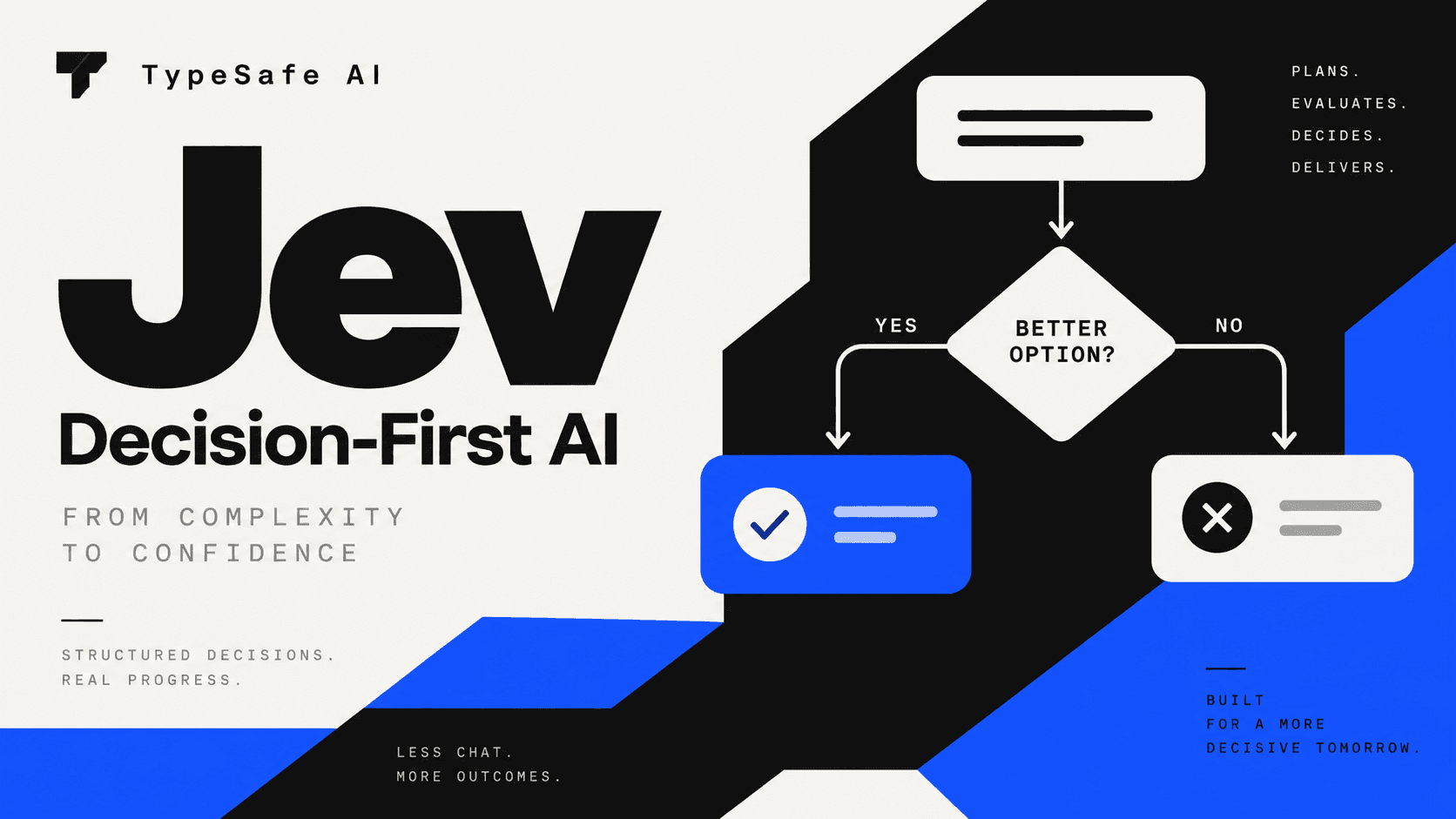
Jev is a new AI model developed by TypeSafe AI that focuses on making structured, probabilistic decisions rather than generating free-form text. TypeSafe describes it as its first System One Model, designed specifically for software automation.
Instead of asking AI to write a paragraph that your application then has to parse, Jev can return the decision your program actually needs.
What Is Jev?
Jev is a decision-focused AI model from TypeSafe AI.
You provide some information, or state, along with predefined questions. Jev analyzes that information and returns structured answers with probabilities and confidence information.
A simple way to think about Jev is:
Traditional LLM: Information → Generated text → Parse response → Make decision
Jev: Information → Structured decision
TypeSafe calls this approach System One AI, inspired by the idea of fast and intuitive decision-making described in Thinking, Fast and Slow.
The goal is not to replace general-purpose language models.
Instead, Jev is built for situations where software already knows the possible actions and needs AI to determine which one makes the most sense.
How Jev Works
A Jev request generally contains two important parts.
The first is the state. This is the information Jev needs to evaluate. It might be text, structured data, application state, or another piece of context.
The second is a set of questions describing the decisions that need to be made.
Current integrations expose decision types such as:
- Choice: Select one option from predefined alternatives.
- Score: Evaluate something against an ordered scale or rubric.
- Boolean: Estimate whether a statement or condition is true.
Multiple questions can be evaluated against the same state in a single request.
Imagine a customer sends this message:
"I was charged twice for my subscription and need this fixed immediately."
Instead of asking an LLM to explain the message, your application could ask Jev questions such as:
Department: Billing, Technical Support, Sales
Priority: Low, Medium, High
Potential refund: True or False
Your application receives structured values that can immediately trigger the appropriate workflow.
Jev vs Traditional LLMs
The biggest difference between Jev and traditional large language models is the type of output they are designed to produce.
Traditional LLMs generate text token by token. That makes them useful for writing, coding, summarization, conversation, and open-ended reasoning.
Jev focuses on structured decisions.
Instead of generating a paragraph and forcing your application to interpret it afterward, Jev can return a predefined choice, score, or probability that software can use directly.
For example, a traditional LLM might respond:
"Based on the message, this appears to be a high-priority billing issue and may require a refund."
Your application would then need to extract the important values.
Jev can instead provide the structured decisions directly:
Department: Billing
Priority: High
Refund required: Likely
This makes Jev especially interesting for automation.
Traditional LLMs remain more suitable when you need flexible text, explanations, code, or conversations. Jev is better suited to cases where the possible outputs are already known.
The two approaches can also work together.
An LLM might generate a customer response while Jev determines whether that response should be automatically sent, reviewed by a human, or regenerated.
Why Developers Are Interested in Jev
The interesting part of Jev is not simply that it can classify information. Classification models have existed for decades.
The difference is the combination of AI-level understanding with an interface designed specifically for software decisions.
Faster Decision Workflows
Because Jev does not need to generate an explanation token by token, TypeSafe reports end-to-end response times between roughly 70 and 500 milliseconds for its service.
That could make it useful for applications where waiting several seconds for an AI response would damage the user experience.
Extremely Low Input Pricing
TypeSafe currently lists Jev's input cost at $42 per billion tokens, equivalent to $0.042 per million input tokens, with output described as too inexpensive to meter separately.
Pricing can change, so developers should verify current rates before designing production economics around them.
Vercel has also integrated Jev into its AI Gateway, making the model available through its AI SDK and HTTP API.
Confidence-Aware Automation
Another interesting feature is probability.
Instead of simply returning:
refund = true
a decision system can return uncertainty that your application can use.
For example:
Refund required: 0.96Your software could automatically process decisions above 0.90 while sending uncertain cases to a human.
This creates a useful pattern:
High confidence → automate
Medium confidence → gather more information
Low confidence → human review
That can be much safer than treating every AI response as equally reliable.
Practical Jev Use Cases
Jev makes the most sense when your application already has a limited set of possible actions.
Customer-support systems could classify incoming messages by department, urgency, sentiment, refund likelihood, or escalation requirements.
AI agents could use Jev to decide whether they should continue working, retry a failed tool, select another tool, ask the user for clarification, or stop the workflow.
Content platforms could score submissions against moderation rules before deciding whether something should be published automatically or reviewed.
Developers could also use Jev as a verification layer around another AI model.
This is where Jev may become particularly interesting.
Instead of replacing the AI agent, it can become the decision layer surrounding the agent.
Can Jev Hallucinate?
TypeSafe says Jev's typed architecture prevents outputs outside the predefined schema.
In other words, if your application specifies three possible choices, the model cannot suddenly return a completely different fourth value.
However, schema correctness is not the same as decision correctness.
Jev can still choose the wrong permitted option.
If the choices are:
Billing
Sales
Technical Support
Jev will return one of those valid values, but it might still classify a difficult request incorrectly.
That distinction matters when building production systems.
Developers should still use confidence thresholds, testing, monitoring, fallback logic, and human review where mistakes carry meaningful consequences.
When Should You Use Jev?
Jev is worth considering when your application needs to repeatedly answer narrow questions over large amounts of information.
Good examples include classification, routing, scoring, verification, guardrails, agent decisions, prioritization, and workflow branching.
Jev is probably not the right model if your application needs to write an article, generate source code, explain a complex topic, conduct an open-ended conversation, or create long-form reasoning.
In those cases, a conventional LLM remains much more appropriate.
The key question is simple:
Does your application need AI to create something, or does it only need AI to decide something?
If it only needs the decision, generating hundreds of tokens of text first may be unnecessary.
What Jev Could Mean for AI Development
For the last several years, AI application development has largely centered around prompts.
Developers send instructions to an LLM, receive generated text, parse it, validate it, and eventually convert it into something their software can use.
Jev suggests another model of AI development.
Instead of making every AI interaction conversational, developers can treat intelligence as another function inside their application.
Traditional code handles deterministic logic.
Generative models handle creation and open-ended reasoning.
Decision models handle ambiguous choices that are difficult to express using ordinary if statements.
That separation could make AI architectures easier to control.
It also explains why Jev has received significant early developer attention.
Key Takeaways
Jev is TypeSafe AI's first System One model, designed around structured decisions instead of generated text.
It can evaluate application state and return choices, scores, boolean probabilities, and confidence information that software can use directly.
Its strongest potential use cases include AI agents, support routing, moderation, verification, guardrails, scoring, and high-volume automation.
Jev does not replace LLMs. Instead, it introduces another useful layer in the AI stack: one optimized for deciding rather than talking.
For developers, that may be the most interesting idea behind Jev.
Sometimes software doesn't need another AI-generated paragraph.
It just needs a smart answer to:
"What should I do next?"
FAQ
Is Jev an LLM?
TypeSafe describes Jev as a System One model rather than a conventional chat-focused LLM. It is optimized for structured probabilistic decisions instead of open-ended text generation.
Who Created Jev?
Jev was developed by TypeSafe AI and publicly introduced in September 2026.
Can Jev Generate Text?
Jev is designed around typed decisions rather than arbitrary free-form text generation. For writing, conversation, or code generation, a traditional LLM is a better fit.
What Can Jev Be Used For?
Common applications include classification, routing, scoring, agent control, guardrails, moderation, verification, and deciding whether automated workflows should continue or escalate.
Is Jev Available for Developers?
Yes. Jev is available through TypeSafe AI and is also supported through Vercel AI Gateway, including AI SDK and HTTP API integrations.