Is AI Killing the Indie Hacker Dream?

Rashid Shahriar
Software Developer
The traditional indie hacker formula sounds simple:
Learn programming, find a small business problem, build a micro SaaS product, launch it online, and improve it until people start paying.
That path still exists. However, powerful AI coding models are rapidly changing which parts of the process create real value.
Anthropic released Claude Opus 5 on July 24, 2026, positioning it as a major improvement for coding, professional work, and long-running AI agents. The model can work across large codebases, follow complex tasks for longer periods, and handle a one-million-token context window.
A recent Fireship video raised the provocative question: has AI made building software so easy that it is destroying the indie hacker opportunity?
The answer is more complicated than either “yes” or “no.”
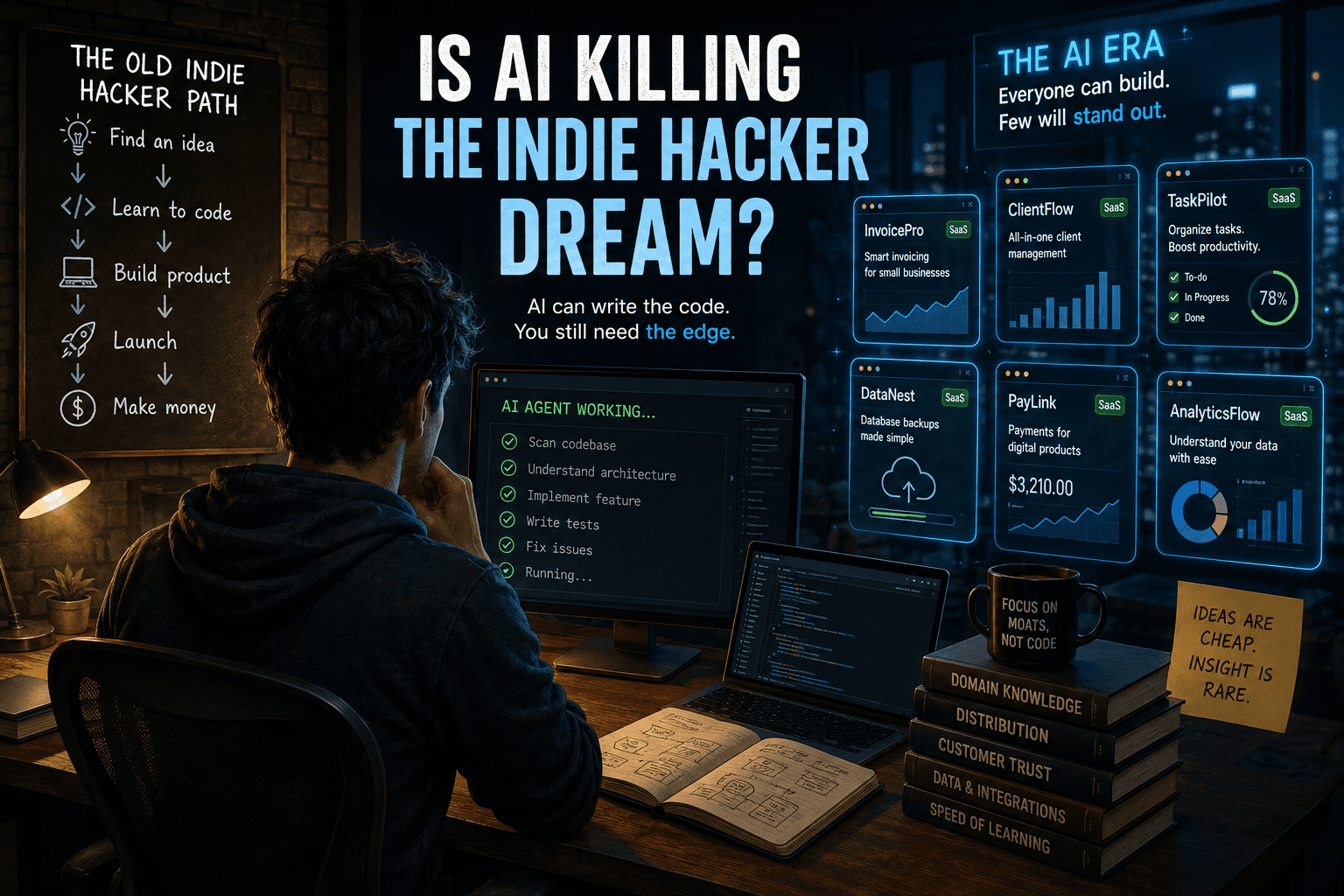
AI is not eliminating indie hacking. It is eliminating coding ability as the main competitive advantage.
Why Claude Opus 5 Changed the Conversation
AI coding assistants are no longer limited to completing individual functions or generating simple landing pages.
Anthropic describes Claude Opus 5 as an agentic coding model designed for long-running, multi-step work. It can understand large codebases, investigate problems, implement features, test its work, and recover from some mistakes without requiring constant human direction.
The model supports:
- A one-million-token context window
- Up to 128,000 output tokens
- Adaptive reasoning
- Codebase-level analysis
- Long-running agent workflows
- Complex feature development and debugging
Its standard API pricing is $5 per million input tokens and $25 per million output tokens—the same pricing Anthropic used for Claude Opus 4.8.
These capabilities matter because they reduce the time, technical knowledge, and money required to turn an idea into working software.
Someone who previously needed months to learn web development may now create a functional prototype in days. An experienced developer using the same tools may accomplish in one week what previously required a small team.
That creates opportunity, but it also creates competition.
The Old Indie Hacker Advantage Is Disappearing
For years, programming knowledge was a significant barrier to entry.
A person who could design a database, build an API, create a user interface, configure payments, and deploy a production application had an advantage over people who only had ideas.
AI is weakening that advantage.
Building a dashboard, authentication system, landing page, CRUD application, browser extension, or basic mobile app is becoming much easier. As a result, generic product ideas can be copied and launched faster.
The Fireship video argues that this changes the traditional indie hacker playbook. When software execution becomes inexpensive, simply being able to build a product is no longer enough.
Consider a basic invoice application. An AI agent can quickly generate:
- Client management
- Invoice forms
- PDF generation
- Payment buttons
- Authentication
- Email notifications
- A basic admin dashboard
But generating these features does not automatically create a successful invoicing business.
The difficult work begins after the first version is built.
AI Can Build Features, but Not Automatically Build a Business
A software product is more than its source code.
Customers pay for a complete and reliable outcome. They care about whether the application works consistently, protects their information, solves the correct problem, and saves them time.
An invoicing platform, for example, still needs reliable payment processing, email delivery, invoice numbering rules, subscription management, data security, reporting, customer support, and a trustworthy brand.
A database backup product must handle scheduled jobs, failed backups, OAuth permissions, storage limits, notifications, encryption, restoration, and privacy concerns.
AI can help implement these systems. However, the founder still needs to decide:
- Which customer problem deserves attention
- What the product should and should not include
- Which failures could seriously affect users
- How the service will earn trust
- How customers will discover it
- Why they should choose it over alternatives
- How the product will remain profitable
Writing code is becoming cheaper. Making good decisions is not.
The New Moats for Indie Hackers
A product moat is something that makes a business difficult to replace or copy.
In the past, technical complexity could provide that protection. Today, indie developers need stronger advantages.
1. Distribution
A technically impressive product without users is still an unsuccessful product.
Search traffic, useful content, partnerships, communities, email audiences, marketplaces, social media, and direct sales are becoming more important.
A competitor may copy your product interface. It is much harder to copy years of search visibility, customer relationships, trusted recommendations, and brand recognition.
2. Domain Knowledge
Developers who deeply understand a specific industry can create better products than someone generating a generic application from a prompt.
Knowing how accountants manage invoices, how farmers record expenses, how universities handle student registrations, or how agencies charge recurring clients provides context that an AI model may not automatically understand.
The strongest product ideas often come from observing real workflows and finding problems that outsiders overlook.
3. Customer Trust
Businesses do not always want to generate their own tools with AI.
They often prefer paying for software that is maintained, secure, documented, tested, and supported.
Trust becomes especially important when a product handles payments, business documents, customer information, backups, or critical operations.
4. Proprietary Data and Integrations
Unique datasets, specialized workflows, historical records, custom integrations, and customer-specific automation are harder to reproduce than a standard interface.
A product connected deeply to a customer’s existing workflow becomes more valuable and more difficult to replace.
5. Speed of Learning
The fastest developer is not necessarily the person who writes code fastest.
The real advantage belongs to the founder who can quickly identify what customers want, release a focused solution, measure its results, and adjust direction.
AI accelerates implementation. It does not guarantee that the implementation is worth building.
Why Developers Still Need Strong Fundamentals
Some people interpret better coding models as a reason to stop learning programming.
I believe the opposite is true.
As AI generates more code, developers must become better at evaluating code.
A developer still needs to recognize:
- Poor database design
- Security vulnerabilities
- Incorrect authorization
- Race conditions
- Unreliable background jobs
- Broken payment flows
- Performance problems
- Invalid architectural decisions
- Missing error handling
- Dangerous deployment configurations
AI can produce code that looks convincing while containing subtle problems. Developers who understand architecture, databases, networking, security, testing, and deployment can identify those problems before customers discover them.
The value of developers is moving from typing every line manually to directing, reviewing, integrating, and maintaining increasingly complex systems.
A Better Indie Hacker Strategy for the AI Era
The goal should not be to compete against AI. The goal should be to use AI while building advantages that AI cannot easily generate.
Validate before building
Speak with potential users, study their current processes, and confirm that the problem is important enough to pay for.
AI makes development faster, but it also makes it easier to waste time building unnecessary products.
Start with a narrow customer
“Software for small businesses” is too broad.
A product for freelance designers who struggle with recurring invoices is more focused. A backup service designed specifically for Supabase projects is easier to explain than a generic cloud backup platform.
Specific positioning makes customer acquisition and product development clearer.
Sell an outcome, not a feature list
Customers rarely buy software because it has React, Laravel, AI agents, or an attractive dashboard.
They buy because it helps them get paid faster, avoid data loss, reduce manual work, organize a business, or make better decisions.
The product message should clearly communicate that outcome.
Use AI as leverage
AI can handle scaffolding, tests, documentation, refactoring, repetitive components, code exploration, debugging assistance, and early prototypes.
That gives solo developers more time for customer research, product strategy, design, marketing, and quality control.
Build publicly with care
Sharing progress can attract users and create accountability. However, publishing every feature, roadmap decision, and market insight may also make copying easier.
Share useful lessons and results, but keep important customer insights, acquisition experiments, and technical advantages private when necessary.
Focus on retention
Launching a product is becoming easier, which means launch announcements have less value by themselves.
The stronger signal is whether customers continue using the product.
Retention shows that the software solves a recurring problem. It also creates feedback, revenue, testimonials, and word-of-mouth growth.
Will Customers Build Their Own Software with AI?
Some will.
Technical users may generate small internal tools instead of purchasing simple SaaS subscriptions. Businesses may also use AI to automate spreadsheets, reports, dashboards, and repetitive tasks.
But most customers do not want to become software companies.
Building an application is only one part of ownership. Someone must still manage hosting, security, updates, backups, bugs, integrations, user accounts, support, and changing requirements.
For many customers, paying for a dependable product will remain cheaper and easier than maintaining an AI-generated application themselves.
This means generic tools with shallow functionality may struggle, while reliable products solving specific and valuable problems can continue to grow.
The Indie Hacker Dream Is Changing, Not Disappearing
AI has not killed indie hacking.
It has made the market faster, noisier, and more competitive.
The ability to build software is becoming widely available. That reduces the advantage of developers who depend entirely on technical execution. At the same time, it gives capable solo founders access to development power that previously required an entire team.
The opportunity now belongs to developers who combine AI with:
- Product judgment
- Technical fundamentals
- Industry knowledge
- Distribution
- Customer relationships
- Reliable execution
- A trusted personal or product brand
The easy version of indie hacking—copying a common product, adding a few features, and waiting for users—is becoming less realistic.
But developers who solve meaningful problems and understand their customers still have an opportunity.
AI may make code cheap. It does not make insight, trust, or good product decisions cheap.
Key Takeaways
- AI is reducing the technical barrier to building software.
- Generic applications and shallow micro SaaS ideas will face more competition.
- Coding remains valuable, but it is no longer a complete competitive advantage.
- Distribution, domain expertise, trust, integrations, and customer insight are becoming stronger moats.
- Developers should use AI to accelerate execution while maintaining control over architecture, security, and product decisions.
- Indie hacking is not ending; the required skills are changing.